
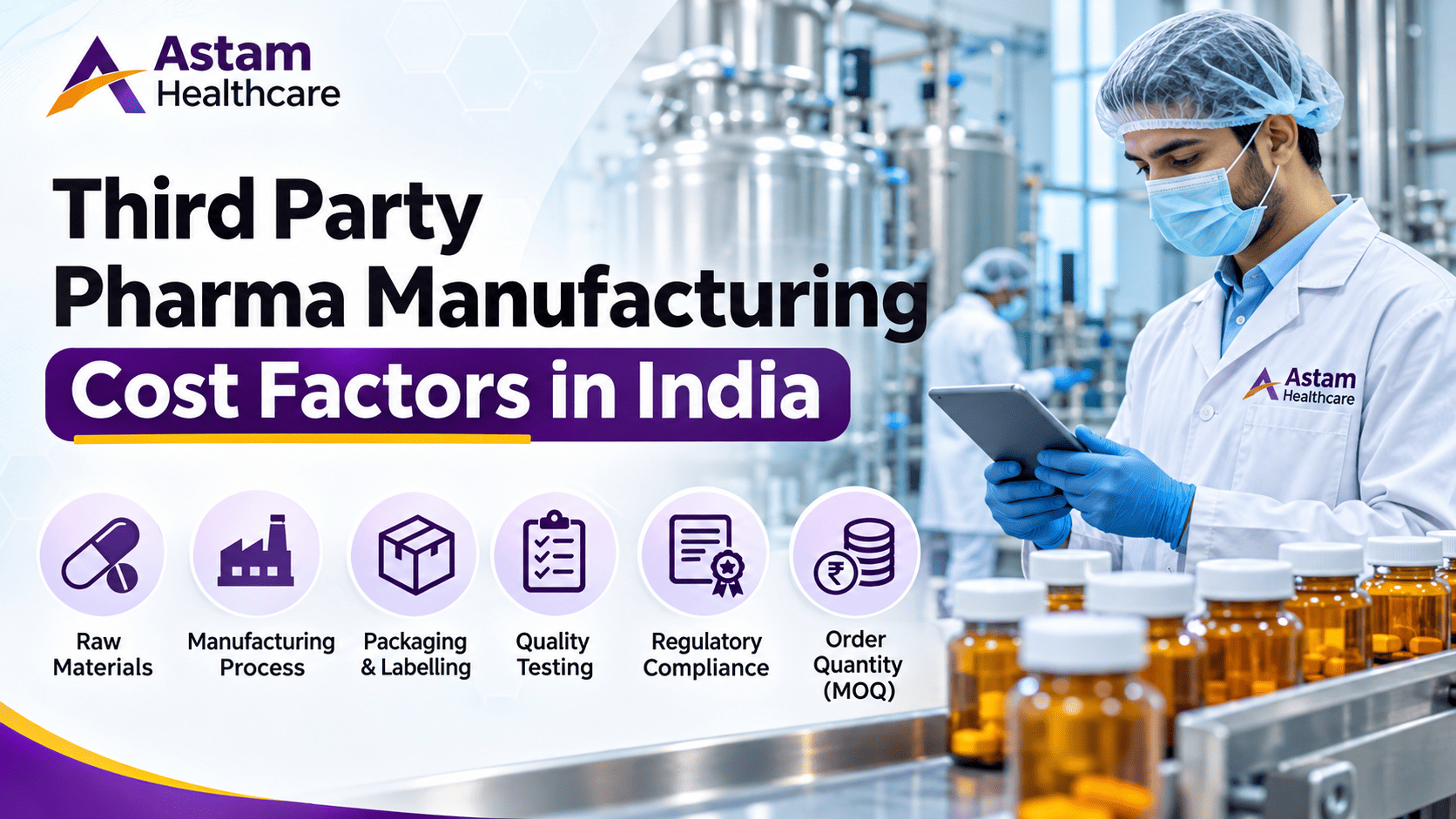
Third Party Pharma Manufacturing Cost Factors in India: A Complete Pricing Guide
Launching a pharmaceutical brand involves several decisions, but one question usually comes up before anything else: how much will manufacturing actually cost?
For pharma marketing companies, distributors and entrepreneurs planning their own medicine range, understanding third party pharma manufacturing cost factors is essential before selecting a manufacturer or placing the first order.
The final manufacturing price depends on much more than the number of tablets, capsules or syrup bottles being ordered. Raw material quality, formulation complexity, minimum order quantity, packaging specifications, quality testing and transportation can all influence the amount a company needs to invest.
A quotation that initially appears affordable may become expensive when additional charges are included. Similarly, the lowest per-unit manufacturing rate may not always offer the most suitable combination of quality, supply reliability and commercial terms.
This guide explains the major factors affecting third party pharmaceutical manufacturing costs in India, how to estimate your total order value and what to discuss with a manufacturing partner such as Adegen Pharma Pvt. Ltd.
What Determines Third Party Pharma Manufacturing Cost?
Third party pharma manufacturing cost is primarily determined by the formulation, raw materials, production quantity, packaging requirements, quality-control activities and commercial terms of the manufacturing agreement.
Additional expenses may include artwork development, documentation, transportation, taxes and inventory financing.
There is no single manufacturing rate that applies to every pharmaceutical product. Even two medicines supplied in similar-looking packaging may have different production costs because of their composition, strength, manufacturing process and quality requirements.
For this reason, pharmaceutical businesses should request product-specific quotations rather than depending on generic manufacturing price lists.
10 Major Factors Affecting Third Party Pharma Manufacturing Cost in India
Understanding these cost factors can help businesses compare quotations more accurately and avoid unnecessary expenditure.
1. Raw Material and Active Pharmaceutical Ingredient Costs
Raw materials are a major component of pharmaceutical production expenses.
Depending on the formulation, a medicine may contain one or more active pharmaceutical ingredients (APIs), excipients and other approved materials.
The procurement cost of these ingredients can vary according to their specifications, supplier availability, quality requirements, sourcing arrangements and market conditions.
For example, a simple oral solid formulation may have a different material cost structure from a combination product containing multiple active ingredients.
Businesses should not assume that medicines within the same therapeutic category will have similar manufacturing costs.
When discussing a quotation, request information about the approved composition and relevant raw-material quality standards.
2. Formulation Type and Manufacturing Complexity
Different dosage forms require different production processes, equipment and quality controls.
Tablets, capsules, syrups, injections, dry syrups, topical preparations and other formulations cannot be priced using one universal manufacturing formula.
A conventional tablet may involve blending, granulation, compression, coating and packaging, depending on the product.
Liquid products may require mixing, filling and other formulation-specific controls.
Sterile products, such as certain injections, involve additional manufacturing and environmental-control considerations.
The complexity of the process affects equipment utilisation, labour, production planning and testing requirements.
This is why the exact dosage form and specifications should be included when requesting a third party manufacturing quotation.
3. Minimum Order Quantity (MOQ)
Minimum order quantity is one of the most important factors affecting per-unit pharmaceutical manufacturing costs.
MOQ refers to the minimum quantity a manufacturer agrees to produce for a particular product or order.
Some manufacturing expenses remain relatively fixed regardless of batch size. These may include production setup, line clearance, equipment preparation and certain quality-related activities.
When those costs are distributed across a larger number of units, the fixed-cost component per unit may decrease.
However, a larger batch also requires greater upfront investment and increases the amount of inventory the buyer must manage.
A lower manufacturing price per unit does not necessarily mean a lower total business cost.
Before accepting a higher MOQ, consider expected product movement, shelf life, storage capacity and available working capital.
Adegen Pharma's third party manufacturing service page states that exact minimum order quantities should be discussed according to product requirements rather than assuming one fixed MOQ for every formulation.
4. Pharmaceutical Packaging Costs
Packaging contributes directly to the final price of a pharmaceutical product.
Depending on the dosage form, packaging may include:
Blister or strip packaging for tablets and capsules.
Bottles, caps and measuring accessories for liquid formulations.
Vials, ampoules or other suitable containers for injectable products.
Tubes, jars or bottles for topical preparations.
Printed cartons, labels and outer shipping materials.
Packaging costs depend on material specifications, printing requirements, order volume and the compatibility of the packaging system with the product.
Customised cartons, special finishes and additional packaging components can increase the production budget.
Packaging selection must also support product protection, approved labelling and applicable regulatory requirements. Cost reduction should never compromise these obligations.
5. Quality Control and Product Testing
Quality-control activities are a necessary part of pharmaceutical manufacturing.
The required tests depend on the formulation, its specifications and the applicable regulatory requirements.
These may involve identity, assay, dissolution, microbial or other product-specific tests.
The manufacturing quotation should clarify which quality-related activities are included in the price and whether any additional approved testing or documentation services have separate charges.
India's regulatory framework includes Good Manufacturing Practices under the Drugs Rules, 1945, including Schedule M requirements.
Quality standards should not be treated as optional expenses that can simply be eliminated to lower production costs.
Businesses should verify applicable manufacturing licences, quality documentation and product-release procedures before finalising an order.
6. Product Development and Custom Formulations
There can be a meaningful cost difference between manufacturing an established formulation and developing a product with customised specifications.
A request involving a new formulation, special excipient selection, unusual dosage form or additional development requirements may involve technical evaluation and development work.
Depending on the circumstances, this may include formulation studies, compatibility assessments, analytical work, stability studies and other applicable activities.
Not every third party manufacturing order requires the same level of development.
A buyer should clearly specify whether the requirement concerns an existing approved product or a new product-development arrangement.
Any development charges should be discussed separately from routine batch manufacturing expenses.
7. Branding, Artwork and Printing Charges
Third party manufacturing is commonly used by pharmaceutical marketing companies that wish to market products under their own approved brand names.
This can involve packaging artwork, label layouts, carton designs, printing plates and other brand-specific requirements.
The cost depends on the scope of design work and the packaging supplier's production arrangements.
Before approving artwork, the brand owner and manufacturer should review the relevant product particulars, mandatory labelling information and commercial responsibilities.
It is useful to ask whether artwork preparation, revisions and printing-related setup charges are included in the quotation.
Changes requested after final artwork approval may result in additional expenses or production delays.
8. Manufacturing Facility and Capacity Requirements
A manufacturer's production facilities, equipment, available capacity and operating requirements can influence commercial pricing.
Different pharmaceutical products may require dedicated manufacturing conditions or specialised equipment.
Production schedules also affect how an order is planned, especially when several product batches must be manufactured during the same period.
A buyer should discuss expected production timelines and realistic dispatch arrangements rather than assuming that every formulation can be supplied immediately.
For a new pharmaceutical business, production consistency and appropriate quality systems may be more valuable than a marginally lower quoted rate.
9. Transportation, Logistics and Storage
Manufacturing expenses do not end when the finished goods leave the production line.
Transportation and handling can add to the delivered cost of medicines.
The actual expense may depend on shipment size, delivery location, packaging dimensions, transport arrangements and product-specific storage requirements.
Some pharmaceutical products require controlled temperature conditions or other special handling throughout transportation.
Before finalising an order, ask whether freight is included in the quotation or charged separately.
Also clarify how damaged shipments, shortages and transit-related concerns are handled.
10. Taxes, Payment Terms and Working Capital
Taxes and payment arrangements are important when calculating the total cost of a manufacturing order.
GST treatment depends on the applicable product or service classification and current tax rules.
Following the GST changes effective from 22 September 2025, most drugs and medicines were placed under a 5% GST rate, while specified medicines received nil-rate treatment. Pharmaceutical manufacturing or job-work arrangements and other services may need separate classification.
Businesses should therefore verify the applicable HSN or SAC classification, current tax treatment and input tax credit implications with a qualified tax professional.
Payment terms also influence working capital.
An order requiring a substantial advance payment may place different financial demands on a business compared with an arrangement involving staged payments.
Calculate the total cash requirement before committing to the first batch.
Third Party Pharma Manufacturing Cost Breakdown
A clear cost breakdown makes it easier to understand where the manufacturing budget is being spent.
| Cost component | What it covers | Cost behaviour |
|---|---|---|
| Raw materials | APIs, excipients and approved ingredients | Varies by composition and sourcing |
| Manufacturing | Processing, equipment and production operations | Depends on batch size and dosage form |
| Packaging | Primary and secondary packaging | Depends on specifications and quantity |
| Quality control | Required testing and batch-release activities | Product-specific |
| Artwork | Brand and pack design requirements | May include one-time charges |
| Documentation | Applicable product or commercial documents | Depends on agreement and requirements |
| Freight | Transportation and handling | Shipment and location dependent |
| Taxes | Applicable GST and other tax considerations | Depends on classification |
| Working capital | Cash committed to production and inventory | Depends on payment and stock cycle |
A quotation should identify which components are included in the base manufacturing price and which are billed separately.
How to Calculate Third Party Pharma Manufacturing Cost
A practical way to estimate the cost is to calculate the total payable amount and then divide the relevant expenditure by the number of saleable units.
Estimated landed cost per unit = Total attributable manufacturing, packaging, testing and logistics cost ÷ Total saleable units
To understand how this works, consider the following hypothetical example.
Illustrative Manufacturing Cost Example
Suppose a pharmaceutical marketing company is planning an order of 10,000 strips of an oral solid formulation.
| Particular | Illustrative amount |
|---|---|
| Base manufacturing and packaging: 10,000 strips × ₹22 | ₹2,20,000 |
| Artwork and printing setup | ₹8,000 |
| Additional agreed testing/documentation | ₹12,000 |
| Freight and handling | ₹5,000 |
| Other agreed expenses | ₹5,000 |
| Total estimated cost before tax | ₹2,50,000 |
Estimated cost per strip = ₹2,50,000 ÷ 10,000 = ₹25
This example demonstrates the calculation method only. The amounts are hypothetical and do not represent Adegen Pharma's prices, a market quotation or a suggested selling price.
Actual testing charges may already be included in a manufacturer's base price. Avoid counting the same cost twice.
GST, recoverable input tax credits, product losses and other accounting treatments must also be considered appropriately when calculating the final financial position.
How Does MOQ Affect Manufacturing Cost Per Unit?
MOQ can affect both price efficiency and inventory risk.
For illustration, assume a product has ₹30,000 in fixed setup-related expenses and ₹18 in variable production cost per unit.
| Batch size | Fixed cost per unit | Estimated total per unit |
|---|---|---|
| 5,000 units | ₹6 | ₹24 |
| 10,000 units | ₹3 | ₹21 |
| 20,000 units | ₹1.50 | ₹19.50 |
These are simplified mathematical assumptions, not actual pharmaceutical manufacturing quotations.
In practice, raw material procurement, equipment capacity, packaging quantities and production constraints can change the economics of different batch sizes.
An entrepreneur should compare the potential unit-price saving with the additional funds tied up in inventory.
If the product has uncertain demand, a smaller commercially viable order may be preferable even when its per-unit cost is higher.
Tablet, Capsule, Syrup and Injection Manufacturing: Cost Differences
Manufacturing cost varies significantly across dosage forms.
Tablet Manufacturing Cost Factors
Tablet quotations may be influenced by API quantity, granulation requirements, coating, compression, batch size and strip or blister specifications.
Capsule Manufacturing Cost Factors
Capsule pricing can depend on the capsule shell, fill formulation, manufacturing process, pack configuration and production volume.
Syrup and Suspension Manufacturing Cost Factors
Liquid formulations involve ingredient sourcing, appropriate processing, bottles, caps, filling operations and product-specific testing and storage co